
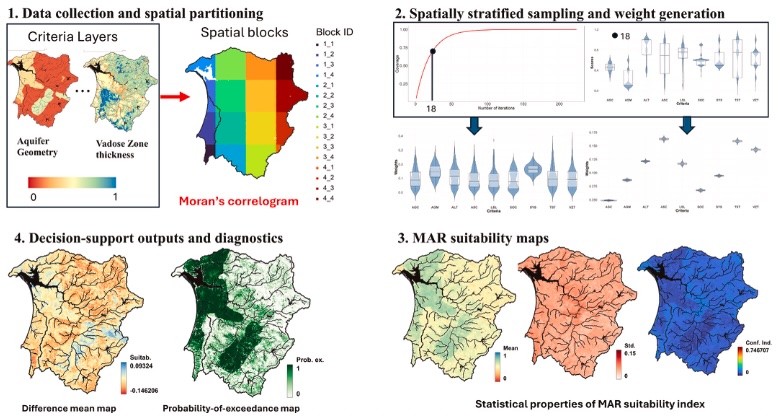
The multi-criteria decision analysis (MCDA) framework is widely recognised as a key component of robust managed aquifer recharge (MAR) planning. However, many existing applications still produce deterministic, “best-estimate” suitability maps that do not fully capture spatial heterogeneity or the uncertainty inherent in the input data. Consequently, their ability to represent local conditions and support uncertainty-informed decision-making remains limited.
To address this limitation, decision-support tools should explicitly account for uncertainty arising from the different sources of information used to identify promising regions for MAR implementation at watershed and regional scales. At this stage, the suitability assessment serves as a screening tool that guides decision-makers in prioritising areas for subsequent, site-specific investigations to evaluate the technical and operational feasibility of MAR implementation.
This study, conducted within the framework of the INVESTWATER Project PRIMA Partnership(Section 1, Innovation Action) in collaboration with Constantinos F. Panagiotou (ERATOSTHENES Centre of Excellence), Tiago Martins (LNEC), Catalin Stefan (Technische Universität Dresden), Marinos Eliades (ERATOSTHENES Centre of Excellence), and Ioannis Varvaris (ERATOSTHENES Centre of Excellence) , presents an uncertainty-aware MCDA framework that explicitly accounts for spatial heterogeneity and spatial autocorrelation. The proposed methodology integrates spatial autocorrelation analysis, stratified random sampling, and multivariate statistical techniques to derive the statistical moments of MAR suitability, together with exceedance-based robustness metrics and decision-support priority indicators. Overall, the proposed framework provides a transferable and adaptive decision-support tool for robust MAR planning under data uncertainty and spatial heterogeneity.
If you are interested for more information, see reference below:
Panagiotou, C. F., Martins, T., Varvaris, I., Eliades, M., & Stefan, C. (2026). Uncertainty-aware MAR planning with spatially explicit data-driven weighting. Science of The Total Environment, 1046, 181984. https://doi.org/10.1016/j.scitotenv.2026.181984